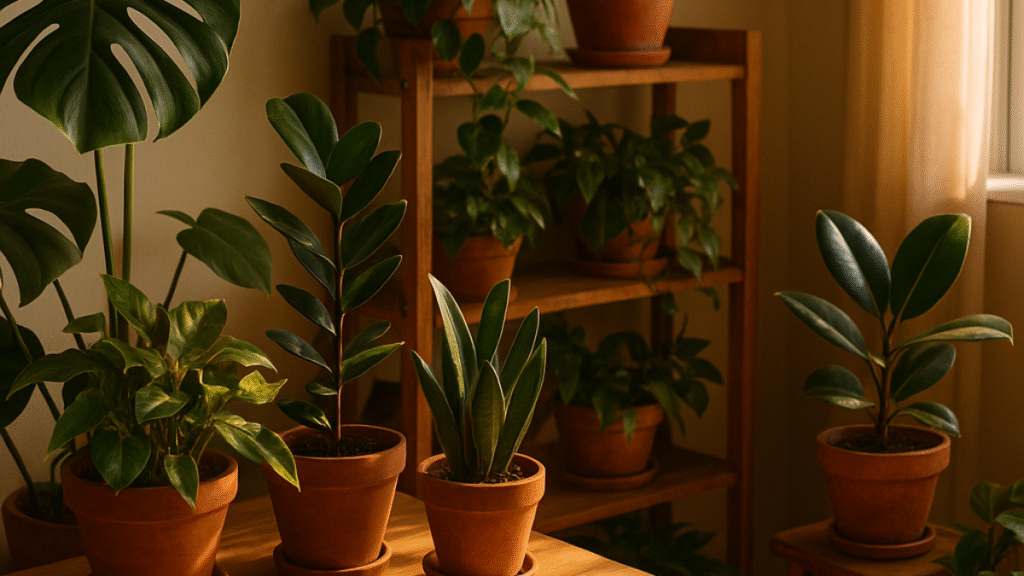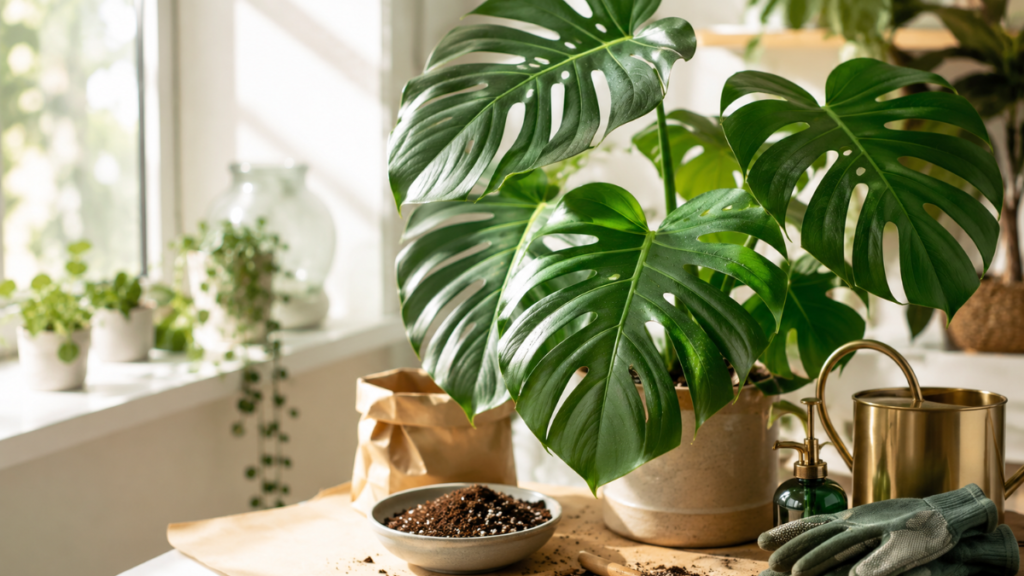
Discover the best-kept secrets of the Monstera deliciosa. A complete guide to help your Swiss cheese plant grow healthy, strong, and fill your home with life.
Has it ever happened to you that you walk into a coffee shop, or see a photo online, and the only thing you notice is that enormous plant with holes in its leaves that looks like it came out of a jungle movie? It used to happen to me constantly.
There was a stretch when I saw that plant everywhere and felt an overwhelming need to have one in my living room. It gave off such a lively energy and made me want to get my hands dirty so badly that I didn’t stop until I got mine. That plant is, as you’ve probably guessed, the Monstera deliciosa, also known as the Swiss cheese plant.
This post contains affiliate links. Using them helps me out at no extra cost to you.
The Origins of the Swiss Cheese Plant: From the Mexican Rainforest to Your Living Room
To really understand any plant, the first thing we have to do is travel to where it was born. We can’t care for something well if we don’t know where it comes from or how it lives in the wild.
Where This Natural Wonder Comes From
The Monstera deliciosa is native to the tropical rainforests of Central and South America, mainly across parts of Mexico, Guatemala, Costa Rica, and Panama.
Picture that environment for a moment: dense forest, tremendous humidity, steady warm temperatures, and giant trees blocking the direct sun.
In its natural habitat, the Monstera doesn’t grow straight up from the ground like an ordinary shrub. It’s an epiphytic climber. That means it uses its aerial roots to grip the trunks of large trees and climbs upward in search of light.
It can reach over 60 feet tall in the rainforest. Obviously it won’t get anywhere near that in our homes, luckily for our ceilings, but knowing this behavior gives us the first golden clue: it needs something to climb to be happy.
Where the Name Comes From and the Story Behind the Holes
The scientific name has a lot behind it. Monstera comes from Latin and means monstrous or strange, a reference to the enormous size its leaves can reach and to their unusual shape.
The deliciosa part isn’t a random adjective either. In the wild it produces an elongated fruit that, according to those who’ve tried it at peak ripeness, tastes wonderful, something like a mix of pineapple, banana, and mango. A word of caution, though: indoors it’s nearly impossible for it to flower and fruit, and the unripe fruit is quite toxic, so we’re better off enjoying the leaves.
In English-speaking countries it’s known as the Swiss cheese plant, for obvious reasons, though in Spanish it’s traditionally called the Adam’s rib plant, because the way the mature leaves split apart brings a rib cage to mind. Those beautiful holes and slits serve a real purpose in nature, and I find it fascinating.
The explanation with the strongest scientific support is about light. Living under enormous trees, sunlight reaches the forest floor in scattered patches, and a leaf full of holes covers a wider area for the same amount of tissue, which raises its chances of catching those moving patches of light. There’s also a popular explanation that says the holes let wind and rain pass through during tropical storms so huge leaves don’t get shredded, though that one has less evidence behind it.
Nature is remarkably clever.
How to Pick the Perfect Monstera at the Nursery
When you go to a garden center or nursery, it’s easy to get excited and grab the first one you see, because they all look gorgeous. To save yourself trouble once you get home, though, it’s worth sharpening your eye and choosing carefully.
What to Check Before You Head to the Register
- Leaf color: look for a plant with bright, even, vivid green. Stay away from ones with yellowing leaves, dark brown spots, or a dull, dusty look.
- Stem firmness: touch the stems gently. They should be firm and upright. If the plant feels limp or soft, it likely has root problems from overwatering.
- Leaf undersides and new growth: check the backs of the leaves carefully, along with the crevices where new stems emerge. That’s where the annoying bugs hide, like mealybugs and spider mites. If you see tiny webs or little white cottony bits, leave it on the shelf.
- Visible roots: it’s normal to see roots poking out the top or through the drainage holes, but if the plant is completely packed in and the plastic pot is bulging from the pressure, you’ll know it needs repotting the moment you get home.
Essential Care to Make Your Monstera Deliciosa Spectacular
Now for the practical part, the day to day. Caring for a Monstera deliciosa isn’t hard, I promise. It’s a fairly tough plant that forgives beginner mistakes, but if you follow the steps that have worked wonders for me, it’ll go from doing fine to being flat-out spectacular.
Light: The Factor That Changes Everything
If you asked me what matters most for a Monstera to develop those giant leaves full of holes, technically called fenestrations, I’d say light without hesitating.
The Swiss cheese plant loves light, but indirect light. Remember where it comes from, under the rainforest canopy.
It needs a very bright room, near a window, but midday direct sun can scorch its leaves irreversibly, leaving ugly brown patches that look like burned skin.
If you put it in a dark corner, the plant will survive because it’s strong, but you’ll notice several things:
- It’ll grow very slowly.
- New leaves will come out smaller and completely solid, with no splits or holes at all.
- The stems will get long, thin, and weak because the plant is stretching desperately toward the light.
My advice: place it 3 to 5 feet from an east- or west-facing window. If your window faces south and gets strong sun, hang a sheer curtain to filter the light and protect it.
Watering: Less Is More
This is where most people go wrong. Too much water is the Monstera’s number one enemy. Because it’s a tropical plant, we tend to assume it needs to stay soaked, and it’s exactly the opposite.
Its roots need to breathe, and if the soil stays waterlogged, they rot within days.
My golden rule is the finger test, or the wooden skewer test. Before watering, push a finger a couple of inches into the soil or slide a skewer all the way to the bottom.
- If the skewer comes out with damp soil stuck to it, don’t water. Wait a few days.
- If it comes out clean and dry, it’s time for a good watering.
When you do water, water thoroughly. Pour evenly across the whole surface until you see it running out the drainage holes.
Let it drain for fifteen or twenty minutes and, this part matters, empty any water left in the saucer or the decorative outer pot. Never let the base of the pot sit in standing water.
In winter, since the plant enters a kind of rest and it’s colder, waterings get much further apart. Once every two or three weeks may be plenty.
In summer, with the heat, the soil dries faster and it may ask for water once or twice a week. Listen to your plant instead of following a fixed calendar.
Temperature and Humidity
Being tropical, the Monstera feels wonderful at the temperatures we usually keep indoors. Its ideal range is 65 to 77 °F. It handles extreme cold badly, and below 50 °F it starts to suffer and stops growing entirely.
Avoid putting it near cold drafts, like the AC in summer, or next to radiators in winter, since the dry heat from heating is brutal on its leaves.
As for humidity, this is the real trick behind those perfectly green tips you see in photos. Our homes in winter, thanks to heating, tend to be very dry. If your Monstera’s leaf tips turn brown and crispy, it’s begging you for moisture in the air.
How do we fix it? There are a few simple options:
- Group your plants: put several plants together. Among them they create a beneficial humid microclimate.
- Pebble tray: set a large saucer under the pot filled with stones or expanded clay. Add water to the saucer without letting it touch the bottom of the pot. The water evaporates slowly around the plant.
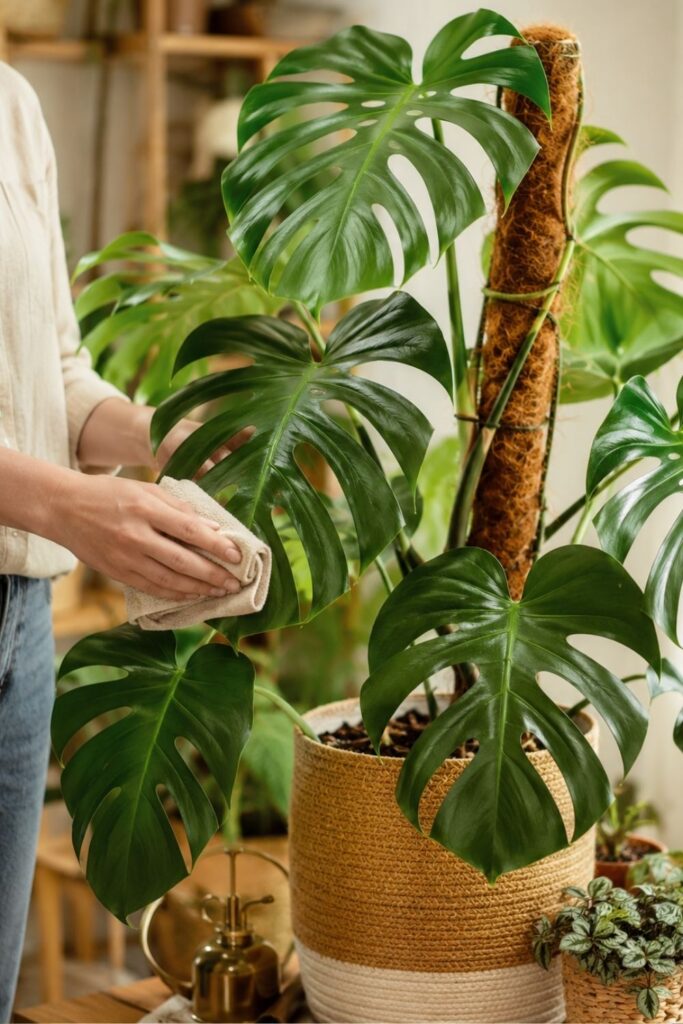
- Wipe with a damp cloth: besides adding moisture, cleaning the leaves with a damp cloth every couple of weeks removes built-up dust and lets the plant photosynthesize much better.
- Humidifier: if your home is extremely dry, running a humidifier a few hours a day will bring it back to life.
Soil, Pot, and Repotting: The Foundation of Success
For the top of the plant to look beautiful, the bottom, meaning the roots, has to be happy and healthy. That’s why we can’t neglect the soil it lives in.
The Ideal Mix for a Monstera
Forget the cheapest bag of soil at the supermarket, the kind that compacts like cement after the second watering. The Monstera needs a mix that’s loose, light, and drains perfectly while still holding a bit of moisture.
I love making my own blend at home. It’s simple and you notice the difference right away. I usually mix:
- 60% good-quality all-purpose potting mix.
- 20% perlite, those little white beads that keep the soil from packing down and let it breathe.
- 20% coco coir or pine bark, like the kind used for orchids, to add texture and lightness.
Toss in a couple of handfuls of worm castings and you’re giving it natural food that will serve it beautifully.
How and When to Repot
The best time to repot a Monstera is spring or early summer, when the plant has the most energy to grow and recover from the stress of the change.
You don’t need to size up every year. Do it only when you clearly see roots coming out the bottom, or when the soil dries out almost the day after watering because there’s barely any soil left, just roots.
When choosing the new pot, go for one only slightly bigger than the last, about 1 to 2 inches more in diameter.
Jump straight to a giant pot and there will be too much soil around the roots holding moisture for too long, which raises the risk of rot. Again, always make sure it has drainage holes.
The Moss Pole: Your Monstera’s Best Friend
As I mentioned at the start, the Monstera is a climber by nature. When it’s young, its stems are relatively short and hold themselves upright.
As it grows and puts out bigger leaves, though, the weight starts to take its toll and the stems flop sideways, sprawling across the floor and taking up a tremendous amount of space.
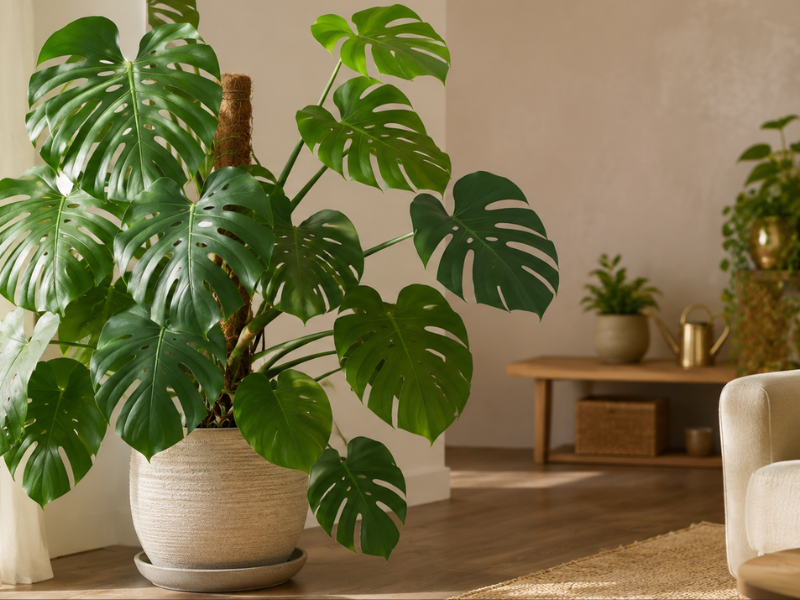
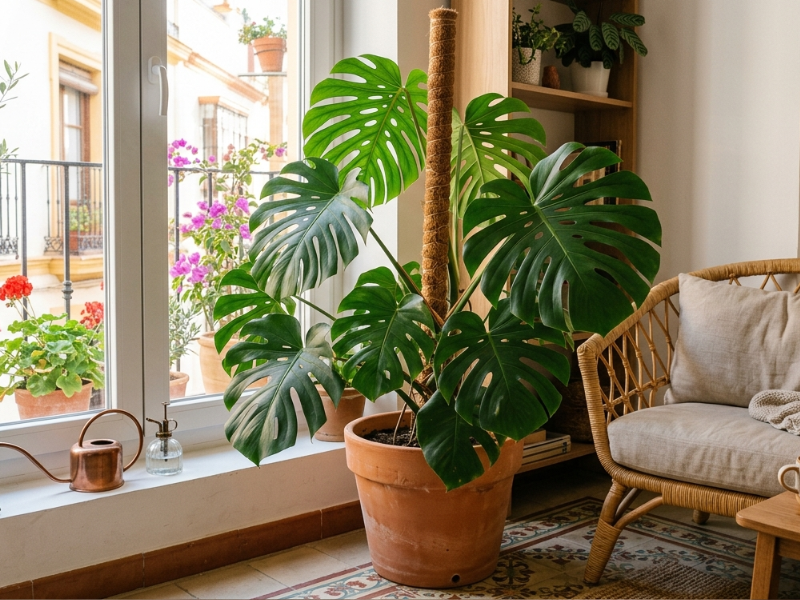
That’s where a support comes in. Adding a good coco coir or moss pole is essential if you want your Monstera to grow upward, elegant, with progressively larger leaves.
How to Install a Moss Pole Without Damaging the Plant
Plenty of people make the mistake of driving the pole in when the plant is already enormous and completely out of control, which can break important roots. The ideal moment is during a repot, or when the plant starts leaning.
- Push the pole in carefully near the center of the pot, all the way to the bottom so it sits firmly.
- Guide the main stems toward the pole. Careful here: tie the main stems, never the petioles, which are the thin stalks connecting each leaf to the stem. Tie the petioles and the plant won’t be able to move its leaves toward the light, and it will suffer.
- Use jute twine, soft fabric strips, or garden ties that won’t cut into the stem. Fasten firmly without strangling it.
- Over time, you’ll see the aerial roots work their way into the coco pole on their own to grip it.
- If you keep the pole damp by misting it now and then, the plant will grip much harder and grow with astonishing vigor.
Feeding and Pruning: The Extra Energy It Needs
How to Feed Your Monstera Without Overdoing It
Through spring and summer, the Monstera runs at full throttle, pushing out one new leaf after another. It burns a lot of energy in that stretch and appreciates an extra nutrient boost.
I recommend a liquid fertilizer for foliage plants diluted into your watering water every two weeks, or once a month if you use a gentler dose.
It’s very important to follow the manufacturer’s instructions and, when in doubt, use a little less than recommended. Overfeeding can burn the roots and ruin the plant entirely.
In fall and winter, stop feeding. The plant is resting and doesn’t need it.
Should You Prune a Monstera?
The Monstera doesn’t need shaping pruning the way a tree does, but a cleanup now and then does it good. If you see old leaves at the bottom that have gone completely yellow, or that have dried up over time, cut them off at the base of the stem with sharp scissors cleaned and disinfected with alcohol.
That way the plant doesn’t spend energy maintaining something already dead, and you improve airflow through the whole plant.
Propagating Your Monstera: How to Get Free Plants
One of the most fun and rewarding things about owning a Monstera deliciosa is how easy it is to propagate. If a friend has fallen in love with your plant, or you want another one for the bedroom, you can take a cutting very simply.
The Secret Is the Node
For a Monstera cutting to take and grow roots, it isn’t enough to snip a leaf off by its stalk. You need to cut a section of stem containing at least one node.
The node is that brown bump on the main stem where leaves and aerial roots emerge. Cut a leaf alone with no node and it’ll stay green in water for months, but it will never grow roots or become a new plant.
Steps for Rooting a Cutting in Water
- Find a stem with one or two healthy leaves and a node with a small aerial root.
- With a sharp, disinfected knife or shears, make a clean cut about an inch below the node.
- Let the cut air-dry for a couple of hours so it calluses over a bit and fungus can’t get in.
- Put the cutting in a glass or vase of clean water, making sure the node and aerial root are submerged while the leaves stay out of the water.
- Set the vase somewhere very bright and change the water once a week so it stays clean and oxygenated.
- Within a few weeks you’ll see strong white roots emerging from the node. Once those roots are about 4 inches long, it’s ready to be potted in the light mix we talked about earlier. You’ve got a new plant!
Long-Term Care and Keeping It in Shape
Once you’ve had a Monstera at home for a few years, you realize that keeping it beautiful long term takes a few details beyond the weekly watering.
Rotating the Plant
Monsteras are very sensitive to the direction of light. Leave it in the same position forever and every leaf will turn toward the window, the plant will grow completely lopsided, and the back will end up bare and scraggly.
To keep a balanced, full, rounded shape, give the pot a quarter turn every time you water. That way it gets light evenly and grows well balanced.
What to Do When It Gets Too Big for Your Home
There comes a point when, if you care for it well, the Monstera can take over half your living room. If it gets away from you, you have two options.
The first is a hard prune of the longest stems in spring, using those cuttings to propagate and rejuvenate the mother plant.
The second is training it horizontally along your walls using special adhesive plant supports, turning the wall into a spectacular green tapestry.
Common Problems: What’s Wrong With Your Monstera and How to Fix It
Even with the best care, things come up. Plants don’t speak in words, but they send us very clear signals through their leaves. Let’s learn to read what your Monstera is trying to say.
Yellow Leaves
If the lower, older leaves turn yellow one at a time very slowly, that’s usually the plant’s natural cycle. If several leaves suddenly yellow at once, though, you’re almost certainly overwatering.
Check the soil. If it’s soaked, stop watering immediately and don’t start again until it’s completely dry. If the pot doesn’t drain well, take the plant out, swap the wet soil for dry, and check that the roots aren’t black and mushy.
Brown, Dry Tips
As we said earlier, this is a clear sign of low humidity. It happens when the air in the room is too dry, usually because of heating or air conditioning.
Use the pebble tray trick, group it with other plants, or run a humidifier to solve it. Don’t cut off a whole leaf over a brown tip. If it bothers you visually, trim just the dry part with scissors, leaving a thin brown margin so you don’t wound the living tissue.
Dark Brown or Black Spots
Pay attention to this one. If the spots appear in the center or along the edges of the leaves and look wet, or come with a yellow halo, it’s usually fungal, caused by prolonged overwatering and poor airflow.
Cut off the affected leaves, treat the plant with a fungicide, and space your waterings much further apart. If the spot is light brown, dry, and crispy in an area right up against the window, it’s sunburn. Move the plant somewhere out of direct sun.
Limp, Drooping Leaves
If the stems look weak, flopping sideways, and the leaves are soft, the plant is thirsty. Check the soil. If it’s completely dry and compacted, give it a good bottom soak by setting the pot in a basin of water for about twenty minutes so the soil rehydrates properly.
Within hours you’ll watch it firm up and stand back up. If the soil is damp and the plant is still limp, the problem is the opposite: the roots have rotted from too much water and can no longer take up moisture.
New Leaves Come Out Small and Without Holes
Your plant is short on food or short on light. The second is more likely. Move it to a corner with much more brightness, always indirect, and you’ll see the next leaves start coming in larger and with those coveted splits.
If it’s already somewhere bright and still doing it, try feeding it during the growing months.
Frequently Asked Questions About the Monstera Deliciosa
Is the Monstera deliciosa toxic to pets?
Yes, unfortunately the Monstera deliciosa contains calcium oxalate crystals in its leaves and stems. If your dogs or cats have a habit of chewing on plants, biting a Monstera can cause severe irritation of the mouth, tongue, and esophagus, along with heavy drooling, trouble swallowing, and vomiting. If you have curious pets, the best move is placing the plant up high, using supports to keep the leaves out of reach, or choosing species that are completely safe for them, like calatheas or prayer plants.
What’s the difference between a Monstera deliciosa and a philodendron?
This is a very common mix-up, and even garden stores sometimes label them wrong. Although they can look similar when young and both belong to the arum family, they’re different genera.
The Monstera deliciosa develops much larger, thicker leaves with those characteristic splits that reach all the way to the leaf edge, plus interior holes.
Philodendrons usually have more elongated heart-shaped leaves, different textures, and different growth habits.
Why does my Monstera drip water from its tips?
This is completely normal and it’s called guttation. It usually happens in the morning, especially after watering.
When the soil is very damp, the roots take up water extremely efficiently, and if the humidity in the room is high too, the plant can’t release that water through normal transpiration.
To relieve that internal pressure, it pushes the excess out as droplets through special pores along the leaf edges called hydathodes.
Don’t worry, it doesn’t mean it’s sick. It’s just telling you it’s well hydrated, or that you may have gone slightly overboard with the last watering.
How fast does a Monstera grow?
The Monstera deliciosa is a fast grower when light and temperature conditions are right. In spring and summer it can push out a new leaf every two or three weeks per main stem.
The first year it may seem slow, but once the root system settles and matures, growth speeds up noticeably.
Why do the aerial roots grow so long, and what should I do with them?
Aerial roots are completely natural and essential for this plant. In the rainforest it uses them to climb and to capture moisture from the air and nutrients from tree bark.
At home, if they get very long, you have three options: guide them carefully into the soil so they become underground roots and give the plant more strength, direct them onto a damp coco pole so they grip it, or simply let them hang, since they give the plant a lovely wild look. Try not to cut them unless it’s strictly necessary or they’ve dried out, because the plant genuinely benefits from having them.
I truly hope this guide helps you lose any fear of this plant and enjoy everything it brings to a home.
At the end of the day, watching a new leaf appear, seeing it slowly unfurl, and discovering what shape and how many holes it’ll have this time is one of those small daily pleasures you never get tired of.
Now I’d love to hear from you. Do you already have a Monstera at home, or are you thinking about getting one? Have you run into any of the problems I mentioned above?
Tell me below in the comments, share your care tricks, or ask me anything. I’d love to chat and swap experiences about our green companions!