Learn how to care for a poinsettia in clear, friendly terms. Find out how to keep it beautiful all year, how to understand its cycles, what it needs in each season, and how to get it to turn red again naturally by following its own biology.
When I Found Out the Poinsettia Isn’t as Delicate as I Thought
Let me be completely honest with you. The first time I owned a poinsettia, I assumed it was a disposable plant. Something you keep around looking pretty at Christmas and that afterward “just dies.” For years, I won’t pretend otherwise, the same thing happened every single time. I’d buy one full of excitement, it would be red and gorgeous, and a few weeks later it would start dropping leaves in the most dramatic way.
Then one year I decided I wanted to really understand it. I started reading botanical studies, looking into light cycles, watching temperature changes, and experimenting at home.
That’s where I found something that completely changed how I see this plant. The poinsettia isn’t fragile, it’s just very honest. It shows you right away when something isn’t working and it responds to every small change. It doesn’t like the cold, it needs more light than we imagine, and its moment of glory, that intense Christmas red, doesn’t appear by magic. There’s a lovely scientific explanation behind it.
When I finally got mine to turn red again without buying a new one, I swear I felt a mix of pride and fascination. It was as if the plant were telling me, “See, you just had to understand me a little.” Ever since then I look at it differently. It’s a plant that teaches me something every year.
That’s why I want to tell you everything I know, in detail but without making it complicated. I want you to understand its biology, its rhythms, and its real needs, and above all to feel capable of caring for it without fear. Let’s take it step by step, because there’s a lot to cover.
What a Poinsettia Really Is and Why It Works the Way It Does
Before we get into poinsettia care, it helps to understand what kind of plant this is, because once you get that, everything else falls into place on its own.
Its “Flowers” Are Not Flowers
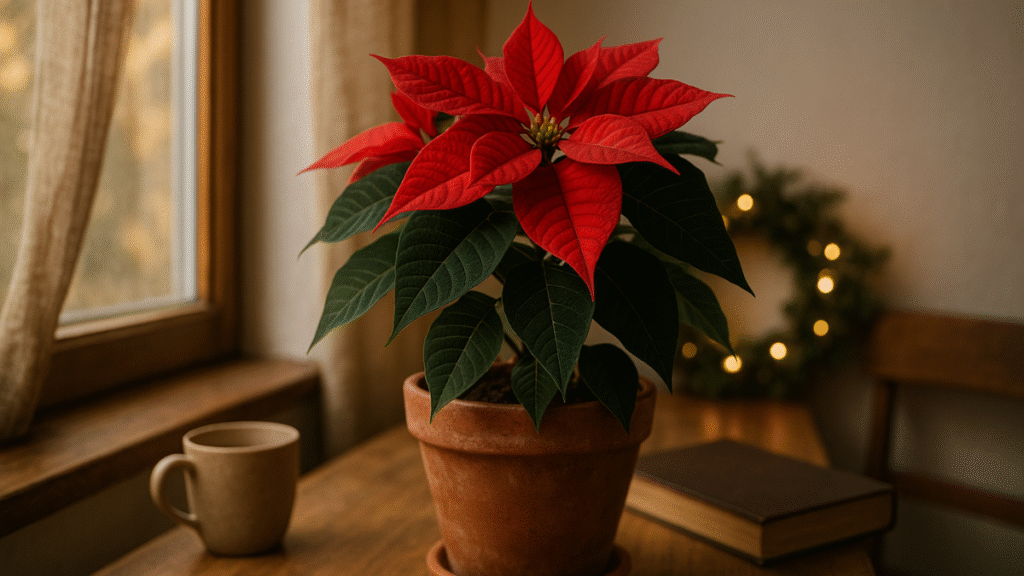
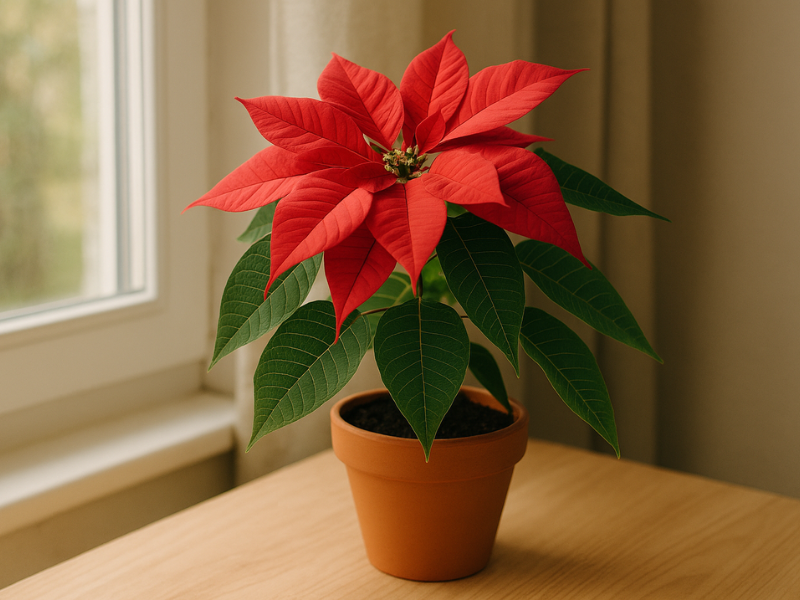
The first thing that surprises almost everyone is that the spectacular red part isn’t made of flowers at all. Those are bracts, modified leaves that take on color to attract pollinators in the wild. The real flowers are those little yellow dots in the middle, called cyathia. They look insignificant, but they’re the key to the plant’s reproduction.
Its Botanical Name and Its Plant Personality
Its scientific name is Euphorbia pulcherrima, and it belongs to the spurge family, which is enormous. Many succulents belong to that same family, so you can already guess this is not exactly a weak plant.
Where It Comes From and How It Lives in the Wild
The poinsettia is native to Mexico and Central America. It can grow several feet tall there, tall enough to be used as an ornamental shrub in tropical gardens. That should tell you it was never built to handle a cold northern winter.
Here’s the most interesting part: in its native habitat, it colors up when the days are at their shortest. That’s the main clue for getting it to turn red again at home.
The Scientific Key: It’s a Short-Day Plant
This detail is essential. The poinsettia needs long hours of darkness to trigger the coloring process in its bracts. Specifically, around fourteen hours a day of total darkness. When I say total, I mean total. No lamps, no lit hallways, no reflections.
Without that cycle, it won’t turn red. It’s that simple and that scientific.
Poinsettia Care: What It Actually Needs
Here comes the practical guide, which is what you’re waiting for. Below I break down poinsettia care in a simple, organized way, based on both real experience and botanical information.
The Light Your Poinsettia Needs
Light is its emotional food, its vitamin, and without it the plant shuts down. It’s probably the single most important factor in poinsettia care.
What It Prefers
Plenty of bright indirect light. The ideal spot is near a sunny window where it gets good brightness for a large part of the day.
What It Won’t Tolerate
Deep shade.
Artificial light as its only source.
Strong direct sun, which can scorch the bracts.
Signs That It Isn’t Getting Enough Light
Leaves dropping from the bottom up.
Dull color.
Weak growth.
When the plant starts losing leaves, it’s almost always the light, not the watering.
The Ideal Temperature
Here’s another crucial point. The poinsettia hates the cold. Really hates it, so put that at the top of your care list.
What It Likes
Temperatures between 65 and 72 °F (18 to 22 °C), steady, with no sudden swings.
What It Can’t Handle
Cold below 54 °F (12 °C).
Drafts.
Heavy heating blasting right at it.
If you buy one at a store in December and they wrap it up for you, that isn’t for looks. It’s to protect it from the cold shock on the way home.
The Perfect Watering Routine for a Poinsettia
This is where most of us go wrong. In our eagerness to take good care of it, we water too much. Like many euphorbias, the poinsettia does not tolerate excess water.
How to Water It Properly
Water when the top of the soil feels dry, soak the potting mix, and let the excess drain away. Always empty the saucer afterward.
What Happens if You Overwater
Sudden leaf drop.
Soft stems.
Fungus showing up.
What Happens if You Underwater
Limp leaves and bracts that lose their firmness.
Soil pulling away from the sides of the pot.
If it helps, think of it as someone who’d rather drink when they’re thirsty than sit around permanently soaked.
Humidity in the Room
We often overlook this one, but the poinsettia notices it a lot. It’s a plant that prefers moderate humidity.
The Ideal Range
Between 40 and 60 percent humidity. With the heating on, indoor humidity can drop to 20 percent, and that’s brutal for this plant.
How to Raise the Humidity
Put a humidifier nearby, or set the pot on a tray of pebbles and water. Grouping it with other plants works too. One thing to avoid: misting the bracts directly, since water can stain them.
The Fertilizer It Needs
The poinsettia needs nutrients on a regular basis to stay strong.
When to Feed It
Once a month in winter.
Every two weeks in spring and summer.
Every twenty days in fall to prepare it for coloring up.
Repotting: When to Touch It and When to Leave It Alone
The best time to repot is spring. Never do it in winter, because the plant is stressed and its root system is more sensitive then. Choose a slightly bigger pot with good drainage, and mix perlite into the soil to keep it airy.
Pruning: The Secret to a Sturdy, Renewed Plant
After the holidays, once the bracts have dropped, it’s time to prune. It’s scary the first time, I know, but it’s the best thing you can do for the plant.
How to Do It
Cut the stems back to about 4 to 6 inches (10 to 15 cm) above the soil, using disinfected shears. The white sap is normal, so don’t panic.
Pruning lets the plant renew its energy and push out new shoots, which are the ones that will color up later on.
How to Get Your Poinsettia to Turn Red Again
Now we get to what everyone wants to know, and also where most of the confusion lives. The reddening is a biological process controlled by light and darkness, so it has nothing to do with special watering or magic fertilizers.
What It Needs
Fourteen hours of absolute darkness for six to eight weeks. The best time to start is late September or early October.
My Method
Keep it in a bright spot during the day, then from six in the evening cover it with an opaque box or move it into a dark closet.
At eight in the morning, bring it back out into the light.
If the dark cycle gets broken one night, the process can be set back, so consistency is what makes the difference here.
How to Tell It’s Working
More compact shoots, smaller new leaves appearing, and a pink tone along the edge of the bracts that keeps deepening.
The first time you see it, you get emotional. It’s as if the plant were thanking you for understanding it.
Poinsettia Care Through the Seasons
To make it easier to keep track, here’s a season-by-season summary.
Winter
This is the trickiest season, and where a lot of plants are lost.
Key care:
-Plenty of natural light.
-Steady temperature.
-Moderate watering.
-No drafts.
Spring
This is a transition period, when the plant recovers from the effort of holding on to its bracts.
What to do:
-Prune.
-Repot if it’s due.
-More light.
-Start feeding regularly.
Summer
This is its season of strong growth.
Care:
-Lots of light, but no direct sun.
-More frequent watering.
-Fertilizer every two weeks.
-It can go outside if the weather is mild.
Fall
This is where the exciting part begins: getting it ready to turn red.
Care:
-Plenty of light during the day.
-The darkness routine at night.
-Light feeding.
The Most Common Problems and How to Fix Them
Here’s a little first aid kit for the typical problems.
Yellow Leaves
Cause: too much water or not enough light.
Fix: let the soil dry out and move it closer to a window.
Leaves That Drop All at Once
Cause: sudden temperature changes.
Fix: move it somewhere stable.
Bracts Losing Color Too Early
Cause: too little light, or the heating is too close.
Fix: more natural light and some distance from the radiator.
It Won’t Turn Red
Cause: the darkness cycle wasn’t followed through.
Fix: opaque box, no exceptions.
Frequently Asked Questions About Poinsettia Care
Is it toxic?
The sap can cause irritation, but the plant is not highly toxic. Its reputation is worse than the reality. Just handle it with care and keep pets from chewing on it.
Can it last several years?
Yes, easily. With good care it can live more than five years.
What do I do if it loses all its leaves?
Check light, watering, and temperature. It usually bounces back in spring.
Can it be pruned hard?
Yes, and it’s recommended. Hard pruning encourages new shoots.
Can it live outdoors?
Yes, in summer and always in the shade.
Caring for a Poinsettia Means Learning to Look Slowly
For me, caring for this plant has meant learning to respect its rhythms and understanding that it isn’t fragile, just sensitive. That sensitivity is exactly what makes it so special. It’s a plant that teaches you to observe and to be patient.
When you see it turn red again thanks to you, to your steady care and your attention, you realize the whole process was worth it.
So, are you up for keeping yours going past Christmas?
Tell me in the comments if you’d like to try it this year, if you’ve already pulled it off before, or if you want me to walk you through yours step by step. I’d love to read you and hear how you care for your own poinsettia.