Discover how to care for a peace lily (Spathiphyllum). A complete guide with expert tricks on watering, light, and blooming so your plant looks better than ever.
People sometimes ask me why I’m so fond of this plant when there are so many exotic varieties out there. The answer is simple: the peace lily talks. No, I haven’t lost my mind. It just has a way of communicating that very few plants can match.
When it’s thirsty, it collapses with drama worthy of a Hollywood actress, and as soon as you give it a little water it perks back up within hours. It’s rewarding, it’s elegant, and honestly, it has an energy that settles any room.
In this guide we’re not only going to cover where to put it or how much to water it. We’re going to understand where it comes from, how it speaks, and how to turn it into the star of your living room. If you’re after a real connection with your plants, you’re in the right place.
The Origins of Spathiphyllum: From the Rainforest to Your Living Room
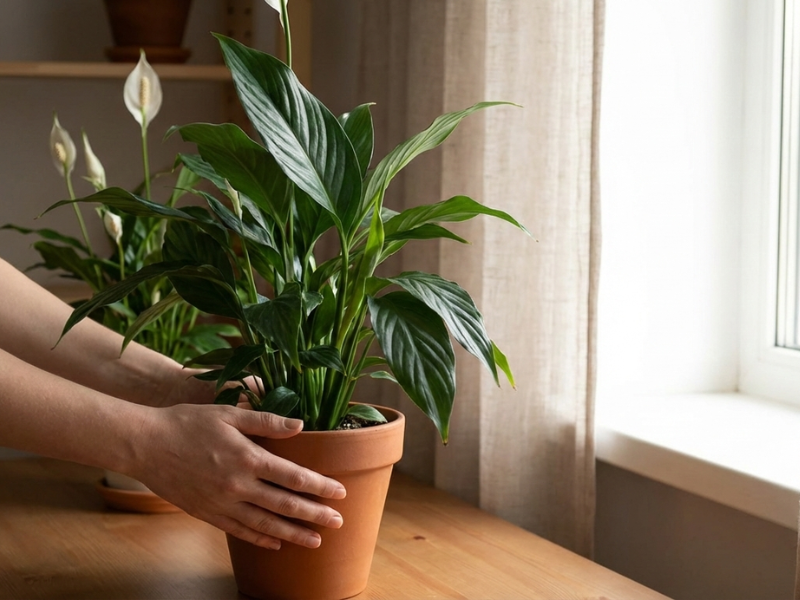
To take good care of someone, or something, you first have to know where they come from. The peace lily isn’t an invention of modern garden centers, it’s a born survivor from the tropical rainforests of Central and South America.
Shelter Under the Forest Canopy
Picture the floor of the Amazon rainforest for a moment. Enormous trees block the direct sunlight, creating an environment of filtered light, high humidity, and steady temperatures. Down there, among the leaf litter and the shade, is where Spathiphyllum feels at home.
That gives us the first golden clue for caring for it indoors:
- It can’t handle direct sun, which literally scorches it.
- It loves humidity in the air, and its leaves will tell you so.
- It likes its roots cool but never waterlogged.
Why Is It Called a Peace Lily?
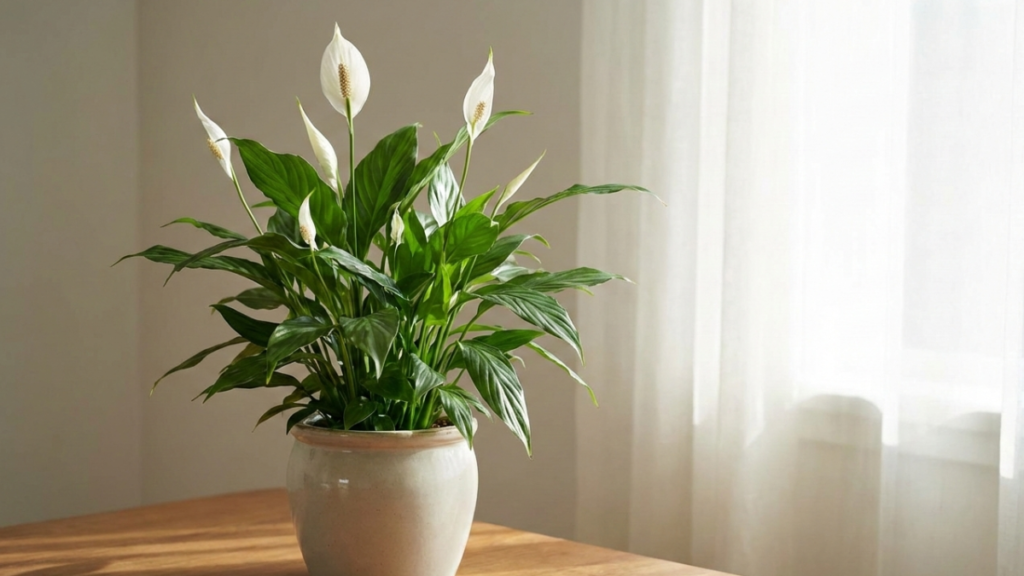
Although we call it a lily, technically it doesn’t belong to the lily family at all, but to the arums, like the Anthurium or the Philodendron. What we see as a white flower is really a spathe, a modified leaf that protects the true flower, which is the spadix, that textured little spike in the center.
It’s associated with peace because of the shape of that white spathe, which brings to mind a white flag of truce. Having one at home isn’t only decorative, it’s a statement of intent about building a calm refuge.
Peace Lily Benefits: Much More Than a Pretty Face
Before we get to the how, let me convince you of why you need one, or three, in your life. This plant is a tireless worker that does a lot for you while asking almost nothing in return.
An Air Purifier Studied by NASA
In the 1980s, NASA ran a famous study on plants that clean the air in enclosed environments, and the peace lily came out near the top. It was shown to filter toxins that are common in our homes, such as:
- Benzene, found in plastics and resins.
- Formaldehyde, found in particleboard furniture and carpets.
- Trichloroethylene, found in some varnishes and paints.
One honest caveat, because you’ll see this claim exaggerated all over the internet: those tests were run inside small sealed chambers. In a real room with normal ventilation, you’d need a lot of plants to measurably clean the air. The peace lily is a wonderful plant, just not a substitute for opening a window.
A Great Match for Humid Rooms
If you have a room that tends to stay humid, the Spathiphyllum is a natural fit. It’s worth being precise here, though: plants don’t dehumidify a room, they actually release moisture into the air through their leaves. What the peace lily does is thrive in exactly the conditions that dry-air plants hate, which makes it the ideal choice for a bathroom with a window or for a bedroom.
Essential Care Guide: The Manual for Never Killing It
Now we get into it. This is where most people go wrong, because they treat every plant the same. The peace lily is easy, but it has its red lines.
The Perfect Spot: Where Do I Put It?
If there’s one thing I’ve learned after years of trial and error, it’s that placement is everything. You can own the best fertilizer in the world, but if the light is wrong, the plant will suffer.
Indirect Light, the Secret to Success
As we said, it comes from the forest floor. Find a spot near a window where the sun’s rays never touch its leaves directly. A window with a sheer curtain is paradise for it. If the leaves turn yellow or develop crispy brown patches, it’s getting too much sun.
The Danger of Drafts
This plant hates sudden temperature changes. Don’t put it right next to a radiator in winter or under the direct blast of the AC in summer. Cold drafts can turn the leaf tips black overnight.
The Art of Watering: Not Too Much, Not Too Little
If there’s one topic that raises questions with the Spathiphyllum, it’s watering. The key here is balance, and it’s a balance the plant itself will teach you to find.
The Peace Lily Drama: When the Leaves Faint
It’s happened to you, I’m sure. You get up in the morning, walk into the living room, and there she is, every leaf drooping, limp, hanging over the rim of the pot as if giving up on life. Don’t panic, it isn’t dying. That’s just how it tells you it’s thirsty.
The peace lily is a very communicative plant. When the soil dries out completely, it loses cell pressure and deflates. The amazing part is that once you water it well, within a few hours it’s standing tall and radiant again. Don’t get too comfortable, though. If you let it reach that point of water stress too often, the plant will gradually weaken and the leaf tips will turn permanently brown. My advice is to act just before the drama gets going.
Overwatering: The Silent Killer
Then there’s the opposite mistake, which is far more dangerous. Many beginners water every single day for fear the plant will suffer. Fatal error. If the roots of a Spathiphyllum sit waterlogged, they can’t breathe and they end up rotting.
How do you know you’ve overdone it? If the lower leaves turn yellow and the base feels soft or smells strange, root rot is very likely. In this case, less is more. Before watering, always stick a finger in the soil. If you feel moisture in the top inch, wait a couple more days.
The Trick of Letting Water Sit
Here’s a small secret that separates a plant that survives from one that shines. Tap water in many cities carries a good amount of chlorine and hard-water minerals, and the peace lily is a little sensitive to them.
What I do is fill the watering can and let it sit for at least 24 hours before using it. That way the chlorine dissipates and the water comes to room temperature, which avoids shocking the roots. Your white blooms will thank you by staying flawless for longer.
Humidity: Recreating the Rainforest in Your Living Room
Remember what we said about its tropical origins. The dry air in our homes, especially when the heating or the AC is running, is the biggest enemy of its leaves. If the leaf tips go brown and crispy, it’s begging you for more moisture in the air.
To Mist or Not to Mist, That Is the Question
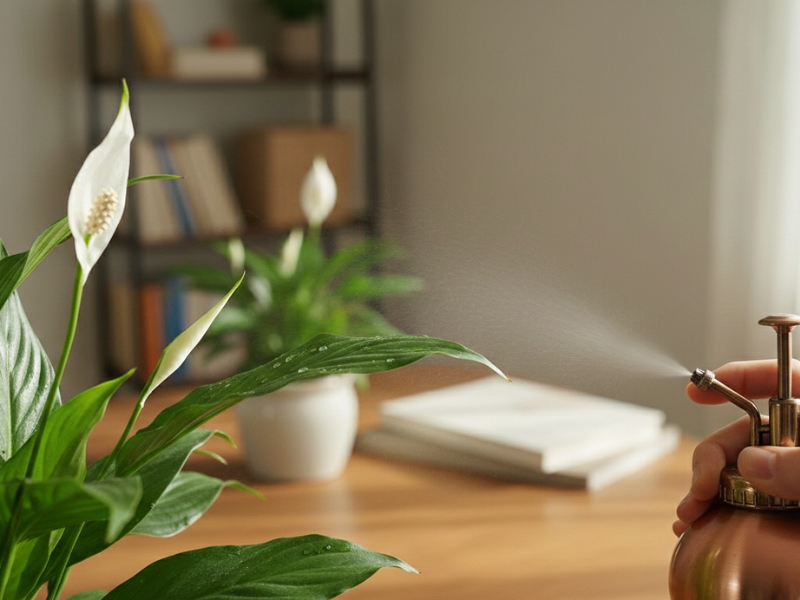
Plenty of people love walking around the house with a spray bottle. The peace lily does enjoy it, but the effect is very short-lived. If you live somewhere with a very dry climate, misting the leaves once a day helps, though it isn’t the real fix. Avoid wetting the white blooms, since standing moisture can leave brown marks on the spathes.
The Foolproof Pebble Tray Trick
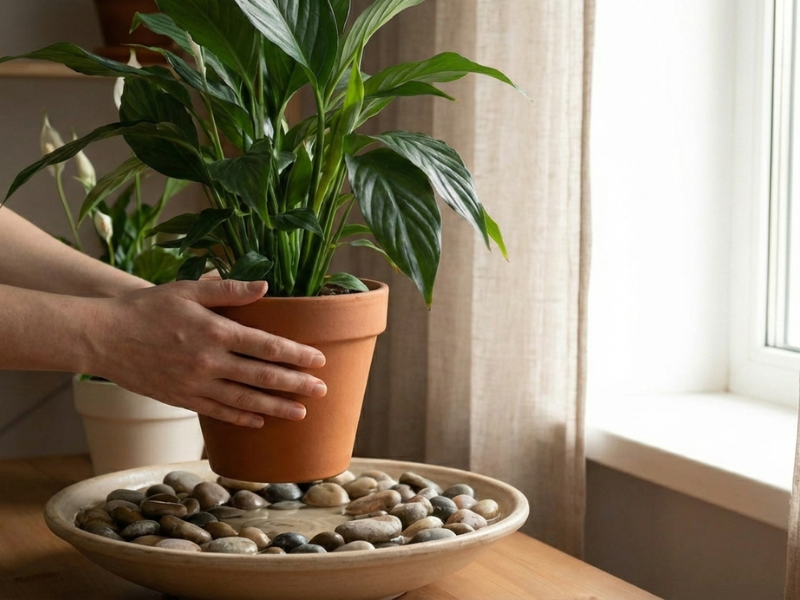
If you want a professional, consistent solution, do this: find a saucer wider than the base of your pot. Fill it with pebbles or small stones and add water without fully covering the stones. Set the pot on top. The water evaporates slowly around the plant, creating a humid microclimate, while the roots never sit in water and never rot. It works wonders for its vitality.
The Perfect Soil: A Mix Your Roots Will Love
Don’t skimp on the soil. The peace lily needs a mix that holds some moisture while draining beautifully at the same time. If you buy the cheapest bag at the supermarket, chances are it will compact like cement and the roots will suffer.
The Ideal Blend for Success
I always mix my own or look for a high-quality option. The ideal is a base of peat or coco coir to hold moisture, blended with a good handful of perlite or vermiculite so air can circulate and excess water can flow through. Add a bit of worm castings on top of that and you’re giving it a feast of organic nutrients that will make it look gorgeous.
Drainage, Drainage, and More Drainage
This one is non-negotiable. Make sure the pot has drainage holes at the bottom. If you’ve fallen in love with a beautiful cachepot that has no holes, don’t put the plant directly into it. Keep it in a plastic pot with holes and use the pretty container purely as a cover. Never let leftover water sit at the bottom of the outer pot after watering. Empty it ten minutes after you’re done.
Repotting: When and How to Give It a New Home
The peace lily grows fairly fast when it’s comfortable. At some point you’ll see roots poking out of the drainage holes, or you’ll notice the plant needs water constantly because there’s barely any soil left to hold it. That’s moving day.
The Perfect Time for the Move
Never repot in the dead of winter unless it’s a total emergency. The best moment is spring or early summer, when the plant has all its energy to spread out into its new home.
When choosing the new pot, don’t go overboard on size. One or two inches wider than the old one is plenty. If you put it in a giant pot, there will be too much damp soil around the roots that the plant can’t take up, which raises the risk of fungal problems.
How to Divide Your Plant and Multiply the Joy
One of my favorite things about Spathiphyllum is how easy it is to propagate by division. When you repot, you’ll see the plant is made up of several clumps of leaves coming out of the soil. You can carefully separate those clumps, making sure each one has a good root system, and pot them individually. From a single plant you can get three or four to give to friends or to fill other corners of your home.
The Master Secret to Spectacular, Steady Blooming
Let’s be honest: most of us buy the peace lily for its flowers. That white spathe that looks like a sail in the wind is pure magic. Then time passes, the blooms it came with fade, and suddenly we have a beautiful plant, sure, but an all-green one. What happened? Why won’t it flower again?
Light Is the Engine of Blooming
If your peace lily is healthy, with green glossy leaves, but won’t produce a single bloom, ninety percent of the time it’s a lack of light. It tolerates darker corners better than most plants, but to generate the energy for flowering it needs brightness.
If you want to see those white spathes again, find the brightest spot in your home where the sun won’t hit it head-on. Within a few weeks you’ll see the first green spikes push up and then open into pure white.
The Plant’s Age and Cycle
Don’t despair if your plant takes a break. Spathiphyllum tends to bloom most strongly in spring and summer, though indoors with good care it can surprise you all year. Very young plants, or ones that were recently divided, also need time to establish their roots before spending energy on flowers. Be patient, nature has its own rhythms.
Why Do the Flowers Turn Green or Brown?
It’s a natural process, though it sometimes worries us. When the flower, meaning the spathe, starts to age, it usually turns green. That’s simply the plant reabsorbing nutrients. My advice is that as soon as you see the bloom lose its whiteness or start to fade, cut it off at the base of the stalk. That way the plant doesn’t spend energy holding on to something that’s already dying and can focus on new leaves or future flowers.
Elite Nutrition: The Feeding Your Plant Needs
If you want your peace lily to be the envy of your guests, you can’t forget to feed it. Imagine if you only ever drank water. You’d run out of energy eventually, right? The same goes for your plant.
The Fertilizing Schedule
During the growing months of spring and summer, I recommend a liquid fertilizer for houseplants or flowering plants every two weeks. I prefer to dilute it a bit more than the label says. Better a little often than a lot at once and burned roots.
In winter, when the plant goes into semi-dormancy, you can stretch feeding to once a month or drop it entirely if you see no new leaves coming. Always water the soil a little before adding fertilizer so the roots don’t take a direct hit when the mix is very dry.
Cleaning and Maintenance: Your Peace Lily’s Private Spa
This is a step a lot of people skip and it’s vital. Spathiphyllum leaves are large and act like magnets for dust. A layer of dust doesn’t just make the plant look neglected, it blocks the pores, called stomata, and gets in the way of photosynthesis and respiration.
How to Clean the Leaves Properly
Once a month, take some time to pamper it. Use a soft cloth dampened with distilled water or rainwater. Wipe each leaf carefully, supporting it from underneath with your other hand so it doesn’t tear.
Avoid those leaf shine sprays on the market. They usually contain oils that clog the plant’s pores over time. For the same reason, skip the old milk-and-water trick you’ll see going around. Milk leaves a residue that blocks those same pores, can go sour, and attracts pests. Plain water on a soft cloth leaves the leaves looking just as good, with none of the downsides.
| Key factor | Ideal requirement | My personal trick |
| Light | Bright indirect | If the plant won’t bloom, it needs a bit more brightness. Move it gently. |
| Water | When the soil dries out somewhat | Don’t wait for full drama. When the leaves start losing firmness, that’s the moment. |
| Humidity | Above 60 percent | A pebble tray with water beats misting, since it creates a constant microclimate. |
| Temperature | Between 65 and 77 °F | Keep it away from the AC vent and the radiator at all costs. |
| Soil | Airy and nutritious | Mix peat with perlite and a bit of worm castings. Your roots will thank you. |
| Feeding | Every two weeks in spring | Use half the dose on the label to avoid burning the roots. |
| Blooming | Encourage by tidying up | Cut the flowers as soon as they turn green so the plant makes new ones. |
| Problems | Brown tips | Almost always the chlorine in the water. Let it sit 24 hours before watering. |
| Safety | Toxic plant | Put it on a high shelf if you have playful cats or dogs at home. |
Troubleshooting: Your Plant Is Sending You Signals
Sometimes, despite our best efforts, the plant starts to look bad. Don’t panic. Let’s decode the visual messages it’s sending.
Brown Leaf Tips
This is the most common problem. It usually comes down to three factors:
- Not enough humidity, meaning the air is too dry.
- Water with a lot of chlorine or hard-water minerals.
- Too much fertilizer, which builds up salts in the soil.
Try improving humidity with the pebble tray we talked about and make sure your watering water is good quality.
Yellow Leaves
If it’s the older leaves at the bottom, that’s just the circle of life. The plant sheds the old to make way for the new. If many leaves yellow at once, though, it’s usually a sign of overwatering or of the plant being cold. Check the soil and make sure there are no drafts.
Uninvited Guests: Common Pests
The peace lily is fairly resistant, but it isn’t immune. Every so often you may see:
- Spider mites: tiny webs on the undersides of the leaves. They usually show up when the air is very dry.
- Mealybugs: little white dots that look like cotton. They come off easily with a cotton swab dipped in rubbing alcohol.
- Aphids: they head straight for tender new growth and the flowers.
If you spot any bug, act fast with insecticidal soap or neem oil, which are eco-friendly and very effective.
Safety at Home: The Peace Lily, Kids, and Pets
This is a serious topic and I want it to be crystal clear. Although the Spathiphyllum is a gem for indoor air, it is not an edible plant. If you have curious cats that chew everything in sight or small children in the taste-test phase of life, you need to be careful.
The peace lily contains calcium oxalate crystals. If chewed, those crystals can irritate the mouth, tongue, and throat, causing drooling or trouble swallowing. It isn’t lethal in small amounts, but it can give you an unnecessary scare and a bad afternoon for your furry companions. My recommendation is to place it up high or on shelves out of reach if you have professional chewers at home.
Myths and Realities: What the Internet Says and What I’ve Tested
Sometimes I read things out there that leave me cold. For example, the idea that a peace lily can live forever in nothing but water in a glass vase. Look, it can survive for a while in a hydroponic setup if you adapt it properly, but that isn’t its ideal long-term state if you want strong blooming. In soil it always has access to a far more complete range of nutrients.
Another myth is that if the plant is drooping you should add sugar to the water. Please don’t. All you’ll accomplish is attracting ants and throwing off the soil pH. If the plant is unwell, what it needs is for you to identify the real cause. Water? Light? Drafts? Don’t go looking for magic solutions from the kitchen cupboard.
Frequently Asked Questions About the Peace Lily
Why does my peace lily have black leaf tips?
This is usually a cry for help for three reasons. The most common is a buildup of salts or chlorine in your watering water. If you use very hard tap water, the tips burn. Another reason is air that’s too dry, especially in winter with the heating on. Try moving it away from radiators and use the pebble tray trick mentioned above. Finally, check that you’re not overdoing the fertilizer, since too much food also burns the tips.
Is it normal for the leaves to turn yellow and drop?
If it’s the leaves at the base, the smallest and oldest ones, it’s completely normal. The plant is making room for new growth. If the upper leaves are yellowing, suspect overwatering. Slide the plant out of its pot and look at the roots. If they’re brown and mushy, you have a rot problem. Let the soil dry out completely before watering again and cross your fingers.
How long does a peace lily flower last?
One of the best things about this plant is how long-lasting its blooms are. They can hold in perfect condition for one to two months. You’ll see them shift from pure white to a greenish tone before they start to fade. It’s a lovely cycle.
Can I keep a peace lily in a windowless bathroom?
The short answer is no. Every plant needs light to photosynthesize. Although the peace lily tolerates low light better than most, in a completely dark bathroom it will slowly die. If your bathroom has even a small window with some brightness, then it will be the happiest plant in the world thanks to the humidity from the shower.
Why isn’t my plant growing even though I take good care of it?
It may need a bigger pot. If the roots have filled all the available space, the plant stalls. It can also be a lack of nutrients. If it’s been more than a year without fresh soil or fertilizer, the poor thing has used up all its reserves. A little worm castings on the top layer of soil will give it the push it needs.
Can I use rainwater to water it?
If only we all could. Rainwater is far and away the best option. No chlorine, no lime, and the pH is perfect. If you have a way to collect water when it rains, your peace lily will thank you by looking greener than ever.
Is it true that it helps you sleep better?
Some studies suggest that having plants in the bedroom improves how rested you feel, though it’s worth being honest about the reason. A single plant doesn’t meaningfully change the oxygen level in a room. The effect seems to come mostly from the calming presence of greenery, and the peace lily is one of the loveliest nightstand companions you can pick.
Conclusion: The Pleasure of Growing Alongside Your Spathiphyllum
Caring for a peace lily is much more than a decorative hobby. For me it’s been a lesson in patience and observation. This plant teaches you that sometimes all we need is a little water and the right spot to stand back up after a bad day. Don’t get frustrated if you make mistakes at first. We’ve all killed a plant or two along the way. What matters is that you now have everything you need to keep it from happening.
I hope this guide becomes your go-to manual. I promise that when you see the first white bloom appear under your care, you’ll feel a satisfaction that few things can match. That’s the magic of connecting with nature inside our own homes.
What about you? Do you already have a peace lily at home, or are you thinking about adopting one? I’d love for you to tell me about your experience in the comments. Have you run into a problem we haven’t covered? Do you have a personal trick you want to share with everyone else? I’m reading closely. Let’s fill the world with white flowers and clean air!